
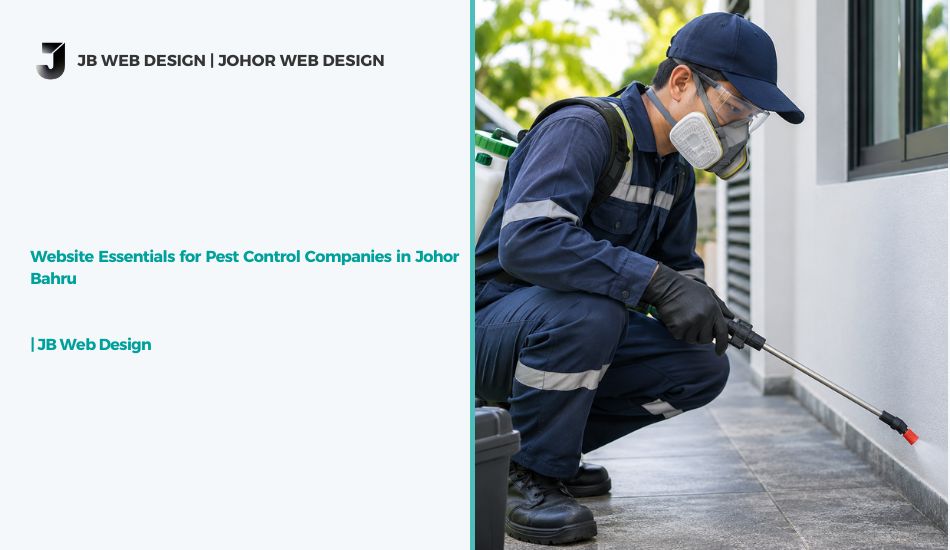
Website Essentials for Pest Control Companies in Johor Bahru
Introduction: A Professional Website Helps Customers Choose the Right Pest Control Company
A professional pest control website design helps customers understand your services, check your company’s credentials and request assistance with confidence. When people discover termites, cockroaches, rats or other pests at home or in their workplace, they usually want a reliable service provider who can explain the problem and offer a suitable solution.
For pest control companies in Johor Bahru, a website is more than an online business card. It is a place to explain your services, introduce your team, display relevant licences and make it easy for customers to contact you. A clear pest control website can also help potential customers compare service options before making a decision.
Whether your company serves residential properties, offices, restaurants, factories or commercial buildings in Johor Bahru and other parts of Johor, your website should answer customers’ basic questions. If you also serve customers from Singapore, make your service coverage and contact arrangements clear. The goal of good pest control website design is simple: help visitors understand what you do and make it easy for them to take the next step.
1. Professional Pest Control Website Design Builds a Strong First Impression
When visitors land on your website, they should quickly understand what your company does. A well-organised pest control website design uses a clean layout, readable text, clear navigation and relevant photographs. The website should look professional without being too complicated.
Your homepage can introduce your company and highlight your main services, such as termite control, general pest management, rodent control and mosquito treatment, if these are services you genuinely provide. Use clear headings and short descriptions so visitors can find the information they need without reading too much.
It is also important to use genuine photographs where possible. Pictures of your team, equipment, service vehicles and actual work environments can help customers understand how your company operates. Avoid using unrelated stock images that may create the wrong impression. A trustworthy pest control website should reflect your real business and the services you can provide.
2. Pest Control Website: Clearly Explain Your Services
A useful pest control website should make it easy for customers to identify the service they need. Different pest problems require different inspection and treatment approaches, so avoid placing every service under one general heading.
Consider creating separate service sections or pages for:
- Termite control: Inspection, treatment options and prevention information.
- Cockroach control: Services for homes, restaurants and commercial premises.
- Rodent control: Inspection, monitoring and measures to reduce rodent activity.
- Mosquito control: Available treatment and prevention services.
- Ant and crawling insect control: Solutions for common indoor and outdoor pest issues.
- Commercial pest management: Services for offices, retail premises, warehouses and other businesses.
Only list services your company actually offers. Explain what each service generally involves and let customers know when an inspection may be required before a quotation can be provided. This approach makes your pest control website design more useful and helps visitors understand the difference between your services.
3. Show Relevant Licences and Professional Credentials
Trust is especially important when customers are choosing a company to carry out pest control work at their property. Your pest control website design should include a section introducing your company’s relevant licences, qualifications and professional experience.
In Malaysia, the Department of Agriculture regulates pest control operator and pesticide applicator licensing under the Pesticides Act 1974 and related regulations. Its published licensing information identifies licences for Pest Control Operators (PCO), pesticide applicators (PA) and assistant pesticide applicators (APA). The requirements depend on the role and the work being carried out.
If your company holds the relevant licences, display accurate information and make sure the details are current. You may include licence information, relevant certificates and staff training details where appropriate. Do not display expired licences or claim that every employee holds a qualification if that is not the case.
You can refer to the Department of Agriculture’s pest control licensing information for official details. A clear credentials section helps make your pest control website more transparent and gives potential customers useful information when comparing service providers.
4. Explain Your Inspection and Treatment Process
Customers may not know what happens after they contact a pest control company. A good pest control website design should explain the service process in simple steps so visitors know what to expect.
For example, your website can describe a typical process:
- Initial enquiry: The customer explains the pest problem and provides the property location.
- Inspection arrangement: Your team determines whether an on-site inspection is needed.
- Assessment: The pest activity, affected areas and possible contributing factors are checked.
- Treatment proposal: Your company explains the recommended approach and quotation.
- Service and follow-up: The agreed work is carried out, with follow-up advice or visits where included in the service.
The actual process will depend on the type of pest, property and treatment required. Avoid promising that every pest problem can be solved in one visit or within a fixed period unless your company can support that claim.
Explaining the process through your pest control website helps reduce uncertainty. It also gives customers a clearer idea of what information they should prepare before requesting a quotation.
5. Include Real Photos, Case Examples and Customer Reviews
Before contacting a service provider, many customers want to know whether the company has experience handling similar problems. Your pest control website design can build confidence by showing genuine photographs, completed project examples and customer feedback.
For example, you may include photographs of inspection work, monitoring equipment, treatment preparation or property maintenance recommendations. If you publish case examples, explain the situation and the work performed without revealing private customer information.
Customer testimonials can also be helpful, but they should be genuine and used with permission. Avoid creating fake reviews or making claims such as “100% pest-free forever” unless there is clear evidence and an appropriate basis for the statement.
A simple gallery or project section can make your pest control website more informative. It allows visitors to see the type of work your team handles instead of relying only on promotional wording.
6. Make It Easy for Customers to Request a Quote
Customers looking for pest control services often want to explain their problem and receive an initial response quickly. A practical pest control website design should make contacting your company straightforward.
Include visible contact options such as:
- WhatsApp enquiry button
- Phone number
- Email address
- Online enquiry form
- Business address and service coverage
Your enquiry form can ask for basic details, including the customer’s name, contact number, property location, type of pest and a short description of the problem. You may also allow customers to upload photographs if your team uses them for preliminary assessment.
For commercial enquiries, consider adding fields for property type, approximate size and preferred inspection date. Keep the form short enough to complete on a mobile phone.
A clear call-to-action, such as “Request a Quote” or “Contact Our Team”, should appear on important pages. Good pest control website design removes unnecessary steps between a customer finding your company and getting in touch.
7. Pest Control Website Design in Johor Bahru: Focus on Local SEO
A website is useful only when potential customers can find it. Local SEO helps your company appear for relevant searches, such as pest control services in Johor Bahru, termite control in Johor or pest management near a customer’s location.
For effective pest control website design in Johor Bahru, include accurate business information throughout your website. Your company name, address, phone number and operating hours should be consistent. Add a service area section explaining which parts of Johor your team covers.
If your company serves areas such as Johor Bahru, Skudai, Iskandar Puteri, Masai or other locations, list only the areas where you genuinely provide services. If you also accept enquiries from Singapore, explain whether services are available there and how customers can make arrangements. Do not suggest that your company operates in Singapore if it does not.
You should also maintain an accurate Google Business Profile with updated contact details, operating hours, service information and genuine photographs. This helps customers find essential information when searching locally.
For further guidance, read our Local SEO Checklist for Malaysia. A search-friendly pest control website should use location keywords naturally while providing useful information for people in the areas you serve.
8. Make Your Website Mobile-Friendly and Fast
Many customers search for pest control services using their smartphones. They may be dealing with an urgent issue and want to call or send a WhatsApp message without navigating through a complicated website.
Your pest control website design should work properly on mobile phones, tablets and desktop computers. Text should be easy to read, buttons should be easy to tap and contact information should be visible without excessive scrolling.
Website speed also matters. Large photographs, unnecessary animations and poorly optimised plugins can slow down pages. Compress images, use reliable hosting and avoid adding features that do not improve the customer experience.
A mobile-friendly pest control website makes it easier for visitors to read about your services, check your coverage and request a quotation. It also supports a smoother browsing experience across different devices.
9. Keep Your Website Updated and Secure
Launching a website is only the beginning. Your pest control website design should be reviewed regularly to make sure that service details, contact information, operating hours and licence information remain accurate.
If your company adds a new service, changes its service area or updates its contact number, remember to update the relevant pages. Remove old promotions and replace outdated photographs when necessary.
Technical maintenance is just as important. Keep your website platform, themes and plugins updated. Check enquiry forms, contact buttons and important links to make sure they work properly. Regular backups and security checks can also help reduce the risk of website problems.
If you use WordPress, our WordPress website maintenance service can help keep your website updated and running smoothly. Regular care helps your pest control website remain useful for both new and returning customers.
Conclusion: Build a Website That Turns Local Searches into Enquiries
A good pest control website design should do more than make your company look professional. It should explain your services, show relevant credentials, describe the treatment process and make it easy for customers to request a quotation.
For pest control companies in Johor Bahru and across Johor, a clear website can help local homeowners and businesses understand your services before contacting your team. If you serve customers from Singapore, make your service coverage and arrangements equally clear.
Start with the essentials: accurate service information, genuine photographs, relevant licence details, simple contact options, mobile-friendly pages and useful local content. A well-planned pest control website gives potential customers a clearer reason to trust your business and take the next step.

Website Essentials for Pest Control Companies in Johor Bahru
Introduction: A Professional Website Helps Customers Choose the Right Pest Control Company
A professional pest control website design helps customers understand your services, check your company’s credentials and request assistance with confidence. When people discover termites, cockroaches, rats or other pests at home or in their workplace, they usually want a reliable service provider who can explain the problem and offer a suitable solution.
For pest control companies in Johor Bahru, a website is more than an online business card. It is a place to explain your services, introduce your team, display relevant licences and make it easy for customers to contact you. A clear pest control website can also help potential customers compare service options before making a decision.
Whether your company serves residential properties, offices, restaurants, factories or commercial buildings in Johor Bahru and other parts of Johor, your website should answer customers’ basic questions. If you also serve customers from Singapore, make your service coverage and contact arrangements clear. The goal of good pest control website design is simple: help visitors understand what you do and make it easy for them to take the next step.
1. Professional Pest Control Website Design Builds a Strong First Impression
When visitors land on your website, they should quickly understand what your company does. A well-organised pest control website design uses a clean layout, readable text, clear navigation and relevant photographs. The website should look professional without being too complicated.
Your homepage can introduce your company and highlight your main services, such as termite control, general pest management, rodent control and mosquito treatment, if these are services you genuinely provide. Use clear headings and short descriptions so visitors can find the information they need without reading too much.
It is also important to use genuine photographs where possible. Pictures of your team, equipment, service vehicles and actual work environments can help customers understand how your company operates. Avoid using unrelated stock images that may create the wrong impression. A trustworthy pest control website should reflect your real business and the services you can provide.
2. Pest Control Website: Clearly Explain Your Services
A useful pest control website should make it easy for customers to identify the service they need. Different pest problems require different inspection and treatment approaches, so avoid placing every service under one general heading.
Consider creating separate service sections or pages for:
- Termite control: Inspection, treatment options and prevention information.
- Cockroach control: Services for homes, restaurants and commercial premises.
- Rodent control: Inspection, monitoring and measures to reduce rodent activity.
- Mosquito control: Available treatment and prevention services.
- Ant and crawling insect control: Solutions for common indoor and outdoor pest issues.
- Commercial pest management: Services for offices, retail premises, warehouses and other businesses.
Only list services your company actually offers. Explain what each service generally involves and let customers know when an inspection may be required before a quotation can be provided. This approach makes your pest control website design more useful and helps visitors understand the difference between your services.
3. Show Relevant Licences and Professional Credentials
Trust is especially important when customers are choosing a company to carry out pest control work at their property. Your pest control website design should include a section introducing your company’s relevant licences, qualifications and professional experience.
In Malaysia, the Department of Agriculture regulates pest control operator and pesticide applicator licensing under the Pesticides Act 1974 and related regulations. Its published licensing information identifies licences for Pest Control Operators (PCO), pesticide applicators (PA) and assistant pesticide applicators (APA). The requirements depend on the role and the work being carried out.
If your company holds the relevant licences, display accurate information and make sure the details are current. You may include licence information, relevant certificates and staff training details where appropriate. Do not display expired licences or claim that every employee holds a qualification if that is not the case.
You can refer to the Department of Agriculture’s pest control licensing information for official details. A clear credentials section helps make your pest control website more transparent and gives potential customers useful information when comparing service providers.
4. Explain Your Inspection and Treatment Process
Customers may not know what happens after they contact a pest control company. A good pest control website design should explain the service process in simple steps so visitors know what to expect.
For example, your website can describe a typical process:
- Initial enquiry: The customer explains the pest problem and provides the property location.
- Inspection arrangement: Your team determines whether an on-site inspection is needed.
- Assessment: The pest activity, affected areas and possible contributing factors are checked.
- Treatment proposal: Your company explains the recommended approach and quotation.
- Service and follow-up: The agreed work is carried out, with follow-up advice or visits where included in the service.
The actual process will depend on the type of pest, property and treatment required. Avoid promising that every pest problem can be solved in one visit or within a fixed period unless your company can support that claim.
Explaining the process through your pest control website helps reduce uncertainty. It also gives customers a clearer idea of what information they should prepare before requesting a quotation.
5. Include Real Photos, Case Examples and Customer Reviews
Before contacting a service provider, many customers want to know whether the company has experience handling similar problems. Your pest control website design can build confidence by showing genuine photographs, completed project examples and customer feedback.
For example, you may include photographs of inspection work, monitoring equipment, treatment preparation or property maintenance recommendations. If you publish case examples, explain the situation and the work performed without revealing private customer information.
Customer testimonials can also be helpful, but they should be genuine and used with permission. Avoid creating fake reviews or making claims such as “100% pest-free forever” unless there is clear evidence and an appropriate basis for the statement.
A simple gallery or project section can make your pest control website more informative. It allows visitors to see the type of work your team handles instead of relying only on promotional wording.
6. Make It Easy for Customers to Request a Quote
Customers looking for pest control services often want to explain their problem and receive an initial response quickly. A practical pest control website design should make contacting your company straightforward.
Include visible contact options such as:
- WhatsApp enquiry button
- Phone number
- Email address
- Online enquiry form
- Business address and service coverage
Your enquiry form can ask for basic details, including the customer’s name, contact number, property location, type of pest and a short description of the problem. You may also allow customers to upload photographs if your team uses them for preliminary assessment.
For commercial enquiries, consider adding fields for property type, approximate size and preferred inspection date. Keep the form short enough to complete on a mobile phone.
A clear call-to-action, such as “Request a Quote” or “Contact Our Team”, should appear on important pages. Good pest control website design removes unnecessary steps between a customer finding your company and getting in touch.
7. Pest Control Website Design in Johor Bahru: Focus on Local SEO
A website is useful only when potential customers can find it. Local SEO helps your company appear for relevant searches, such as pest control services in Johor Bahru, termite control in Johor or pest management near a customer’s location.
For effective pest control website design in Johor Bahru, include accurate business information throughout your website. Your company name, address, phone number and operating hours should be consistent. Add a service area section explaining which parts of Johor your team covers.
If your company serves areas such as Johor Bahru, Skudai, Iskandar Puteri, Masai or other locations, list only the areas where you genuinely provide services. If you also accept enquiries from Singapore, explain whether services are available there and how customers can make arrangements. Do not suggest that your company operates in Singapore if it does not.
You should also maintain an accurate Google Business Profile with updated contact details, operating hours, service information and genuine photographs. This helps customers find essential information when searching locally.
For further guidance, read our Local SEO Checklist for Malaysia. A search-friendly pest control website should use location keywords naturally while providing useful information for people in the areas you serve.
8. Make Your Website Mobile-Friendly and Fast
Many customers search for pest control services using their smartphones. They may be dealing with an urgent issue and want to call or send a WhatsApp message without navigating through a complicated website.
Your pest control website design should work properly on mobile phones, tablets and desktop computers. Text should be easy to read, buttons should be easy to tap and contact information should be visible without excessive scrolling.
Website speed also matters. Large photographs, unnecessary animations and poorly optimised plugins can slow down pages. Compress images, use reliable hosting and avoid adding features that do not improve the customer experience.
A mobile-friendly pest control website makes it easier for visitors to read about your services, check your coverage and request a quotation. It also supports a smoother browsing experience across different devices.
9. Keep Your Website Updated and Secure
Launching a website is only the beginning. Your pest control website design should be reviewed regularly to make sure that service details, contact information, operating hours and licence information remain accurate.
If your company adds a new service, changes its service area or updates its contact number, remember to update the relevant pages. Remove old promotions and replace outdated photographs when necessary.
Technical maintenance is just as important. Keep your website platform, themes and plugins updated. Check enquiry forms, contact buttons and important links to make sure they work properly. Regular backups and security checks can also help reduce the risk of website problems.
If you use WordPress, our WordPress website maintenance service can help keep your website updated and running smoothly. Regular care helps your pest control website remain useful for both new and returning customers.
Conclusion: Build a Website That Turns Local Searches into Enquiries
A good pest control website design should do more than make your company look professional. It should explain your services, show relevant credentials, describe the treatment process and make it easy for customers to request a quotation.
For pest control companies in Johor Bahru and across Johor, a clear website can help local homeowners and businesses understand your services before contacting your team. If you serve customers from Singapore, make your service coverage and arrangements equally clear.
Start with the essentials: accurate service information, genuine photographs, relevant licence details, simple contact options, mobile-friendly pages and useful local content. A well-planned pest control website gives potential customers a clearer reason to trust your business and take the next step.